

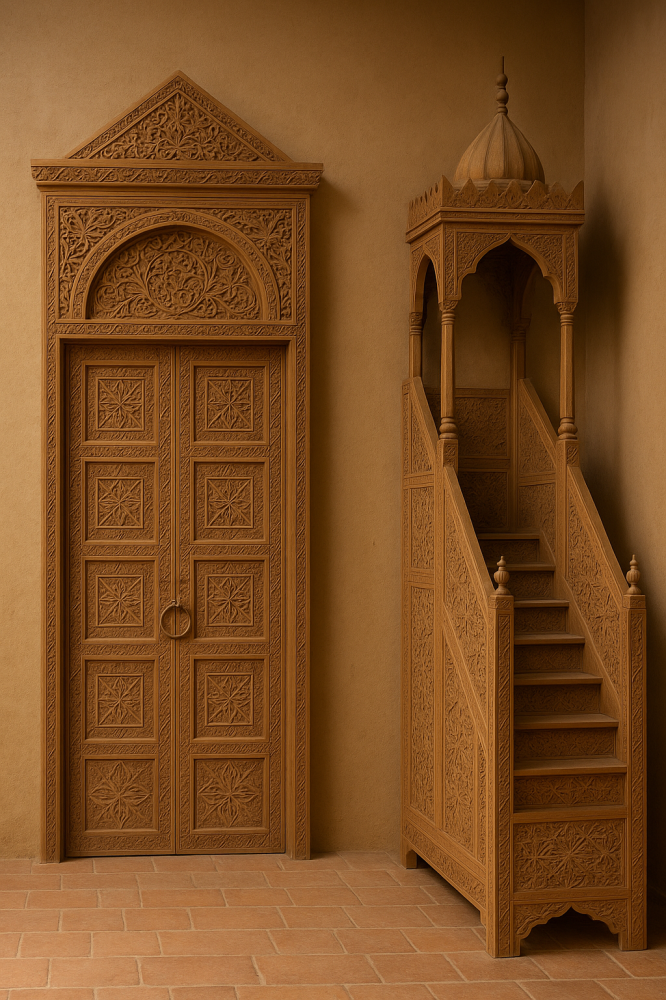
Pulpits and Doors: How did the Najdis express their identity through wood carvings?
Written by: Sculpture Masterpieces
In the heart of Najd, where the desert straddles history and culture, wood was not just a building material; it was a means of expression, identity, and aesthetic uniqueness. The Najdis used wood to carve mosque pulpits and house doors, creating a visual heritage that carries their religious and social symbols and speaks to their ancient arts.
Art beyond function
Najdi pulpits were not simply crafted for the preacher to ascend. Rather, they were a work of art in themselves, reflecting the craftsman's mastery and deep understanding of the surrounding environment. These pulpits were distinguished by their delicate lines and decorative engravings, which intertwined abstract flowers, geometric shapes, and Quranic verses written in Naskh or Thuluth script. These details were not in vain; rather, they expressed piety, skill, and belonging to a culture that sought beauty even in the simplest details.
Doors... the story of the house from the outside
House doors were the first page of the story of the interior. In Najdi cities such as Riyadh and Diriyah, doors were crafted from tamarisk or jujube wood, then hand-carved in a unique style. Some doors were inscribed in Arabic calligraphy with the names of the homeowners, verses protecting against the evil eye, or prayers welcoming visitors. The inscriptions bore symbols familiar to the residents, expressing belonging and the family's particular taste.
Decoration as identity
Wood decoration in Najd was not inspired by chance; rather, it reflected Islamic culture and the desert environment. Najdis favored simple geometric repetition and avoided depicting living beings, adhering to Islamic traditions. The balance in design and the discipline of repetition reflect the character of the people of Najd: clear, organized, and purposeful.
Between the maker and the community
The Najdi woodworker was not just a craftsman. He was a cultured artist who knew how to satisfy societal tastes while preserving aesthetic and religious values. The woodworker was regarded as a man of status, possessing a knowledge that few could master, and leaving his mark on people's homes and mosques.
The lasting legacy
Despite the changing times, some of these pulpits and doors are still preserved, displayed in museums or nestled in old houses, telling of a time when hands carved faith and identity into wood. They are not mere relics, but enduring messages from a society that knew how to transform simple material into a mirror of its soul.
In the art of Najdi engraving, we see more than just shapes, but rather hear the silent story of a people who used their simple tools to leave an everlasting impression. These are masterpieces of sculpture, but above all, they are masterpieces of humanity.